Travel to Alaska
by Bekir Hodzic ’26
I arrived in Juneau, Alaska, to an emergency warning blaring from my phone. Suicide Basin, a glacial lake formed by melting water from the Mendenhall Glacier—found above the city—was about to overflow, sending flood waters into it. Thankfully, I quickly learned that the local government had prepared barriers to block those waves, and during my four days in Juneau, I heard few reports of catastrophe.
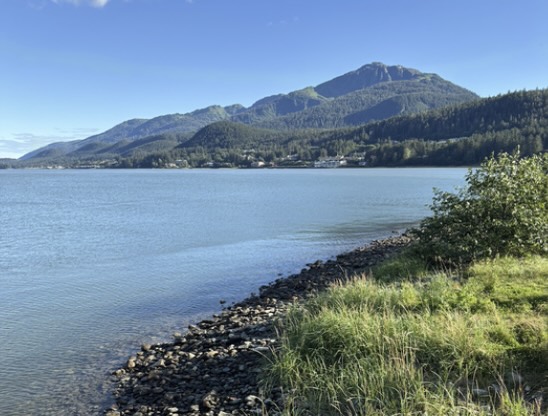
Mendenhall Glacier’s flooding comprises a recent phenomenon, driven by climate change. Its name is also relatively recent: the U.S. Coast and Geodetic Survey named it in 1891 to honor Thomas Corwin Mendenhall, a famed American meteorologist. In the centuries before that coining, however, the glacier carried a different name, given to it by the Tlingit communities that called this part of Southeastern Alaska their homelands: Áakʼw Tʼáak Sítʼ. Like with many things across the state, American colonial rule, first introduced to Alaska in 1867, had deeply impacted the human and physical geographies surrounding the natural formation.
Thanks to the Evalyn Clark Memorial Travel Fellowship, I was able to travel to Juneau to research one of those imperial reverberations for my senior thesis: U.S. citizenship and its application to southeastern Alaska’s Indigenous peoples. More specifically, my thesis analyzes how Alaska Natives engaged with, challenged, and reshaped American citizenship throughout the early-twentieth century in Alaska. I focus on a law passed by the Alaska territorial legislature in 1915 that allowed Indigenous individuals to become citizens by completing an arduous judicial process, uncovering how Natives sought and negotiated citizenship to fortify their individual and communal rights.
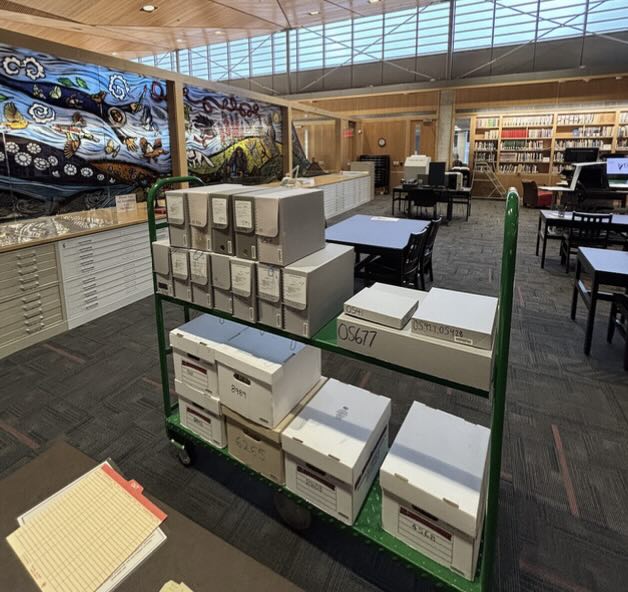
To enable my research, I visited the Alaska State Archives and the Sealaska Heritage Institute in Juneau, which house voluminous collections of Indigenous-made and Indigenous-related historical materials, from newspapers made by Native boarding school students to legislative minutes from the territorial Alaskan legislature. The Alaska State Archives (ASA) occupied most of my trip time. I arrived there and found myself face-to-face with a two-tier cart carrying well over fifteen boxes of documents. I spent the next three days poring over and scanning the items before me. Some of my favorite discoveries included: the original application files for the over 120 Alaska Natives that pursued citizenship under the 1915 law; political programs produced by the Alaska Native Brotherhood (ANB), a Native rights organization founded in 1912; and court records linked to United States v. Charlie Jones, a 1923 case where the U.S. government sued a Native man for illegal voting that forms an essential part of my thesis’ final chapter.
After my time at the ASA ended, I devoted my last day in Juneau to exploring the Sealaska Heritage Institute’s (SHI) archives. The SHI is an Indigenous-founded and Indigenous-led non-profit dedicated to advancing Southeastern Alaska’s Tlingit, Haida, and Tsimshian cultures; while there, I was not only able to investigate historical records, but also interact with ongoing efforts by Alaska Natives to preserve their histories and orient them toward Indigenous futures. So while I spent much of that Thursday shored up in the SHI’s basement looking at ANB meeting minutes and the original versions of citizenship certificates given to Natives through the 1915 law, I additionally ensured that I saw the Institute’s vast public displays of Indigenous art and spoke with some of its employees about their current work.
I left Juneau the next morning, sad to see the city go, but appreciative of the archival experience it provided me and the chance to see so many elements of my Vassar education activate simultaneously—whether from my History major or Native American Studies correlate. I hope to go on many other such trips, in Alaska and beyond.