Great Green Hope for the Urban Blues: Art and Myths of the Hudson Valley
About the publication
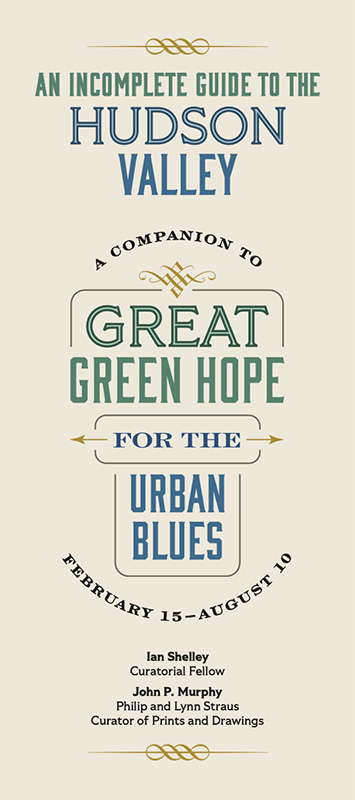
Two hundred years ago, the landscape painter Thomas Cole traveled up the Hudson River to paint the Catskill Mountains, a voyage that marked the mythical origin of the so-called “Hudson River School” of art. In subsequent centuries, artists have continued to portray the Hudson Valley as an earthly paradise remote from the modern world. Artists imagined the region as a promised land of religious freedom, a haven of ethnic identity, an opportunity to reconnect with nature, and a space to experiment with alternative lifestyles. In the words of one New York journalist, the Valley became the “great green hope” for the “urban blues.” At the same time, this enduring pastoral myth cloaks the region’s active ties to urban tourism and trade while obscuring histories of violent settlement, enslaved labor, and resource extraction. Gathering historic and contemporary art in various media, the exhibition invites viewers to explore how the Hudson Valley has been pictured as a place both proximate to the city and its opposite—a “great green hope” as much myth as reality.
This exhibition and brochure were organized by Ian Shelly, Curatorial Fellow, and John P. Murphy, Philip and Lynn Straus Curator of Prints and Drawings. Great Green Hope for the Urban Blues kicked off the Loeb initiative, generously supported by the Terra Foundation for American Art, to reinterpret and reinstall the museum’s significant collection of Hudson River School art.
Exhibition: February 15–August 17, 2025
Price: Complimentary
To request a copy, email Francine Brown or call (845) 437-5237.

Perspectives from Students
124 Raymond Ave
Poughkeepsie, NY 12604
Main (845) 437-5237 | Info (845) 437-5632