Splitting the Horizon: Frederic Church Between Border and Bridge
February 21–August 30, 2026
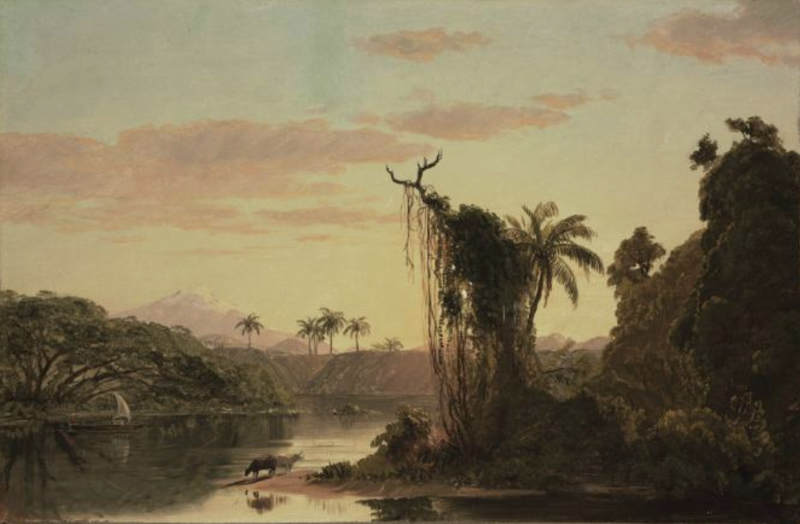
This year marks the 200th anniversary of landscape painter Frederic Church’s birth. Traveling to Colombia and Ecuador and returning through Panama in 1853, Church sought to domesticate the sprawling South American wilderness for display in the intimate exhibition rooms of American cities. In the works that emerged from this trip, Church applied a nostalgic gaze meant to reinscribe a cultural heritage of “untouched nature” into the American landscape. Shaped by an underlying belief in a God-given right to conquer exotic lands, the everyday citizen-spectator who viewed his work would adopt imperial lenses to survey and visually lay claim to the Southern Hemisphere. The expansionist ideologies underlying Church’s works normalized for the American public a manifest destiny which led to the sanitization and excavation of the Panamanian mountains as part of the building of the Panama Canal. Church and other landscape painters’ depictions of the so-called “wild” contradictorily rendered the land empty and uninhabited, promoting a terrain for capital production. Summer in South America and Autumn in North America are a part of Vassar’s founding art collection given by Matthew Vassar in 1864 and represent Church’s melding of the two hemispheres. However, this linkage was uneven as northern sentiments of sovereignty towards southern resources formed borders instead of bridges, culminating with the Panama Canal ripping through a geographic bridge to create an artificial one that connects the east and west coasts of the United States.
Splitting the Horizon was organized by 2025 Ford Scholar/Pindyck Summer Fellow, Ashleigh McDermott, Vassar College class of 2026. Support for Spotlight is provided by Mary Ellen Weisl Rudolph ’61, P ’98 and James N. Rudolph P ’98.
This display is part of the Frederic Church 200 initiative, launched by the Olana Partnership to celebrate and extend the artist’s legacy on the bicentenary of his birth. For more information, visit Olana.org.


Perspectives from Students
124 Raymond Ave
Poughkeepsie, NY 12604
Main (845) 437-5237 | Info (845) 437-5632