Shedding Light on Dark Matter
Renowned astronomer Vera C. Rubin ’48 was only 10 years old when she built a telescope out of cardboard to observe and track meteors. When she was older, Rubin ignored advice against pursuing a career in science and graduated from Vassar College with a degree in astronomy.
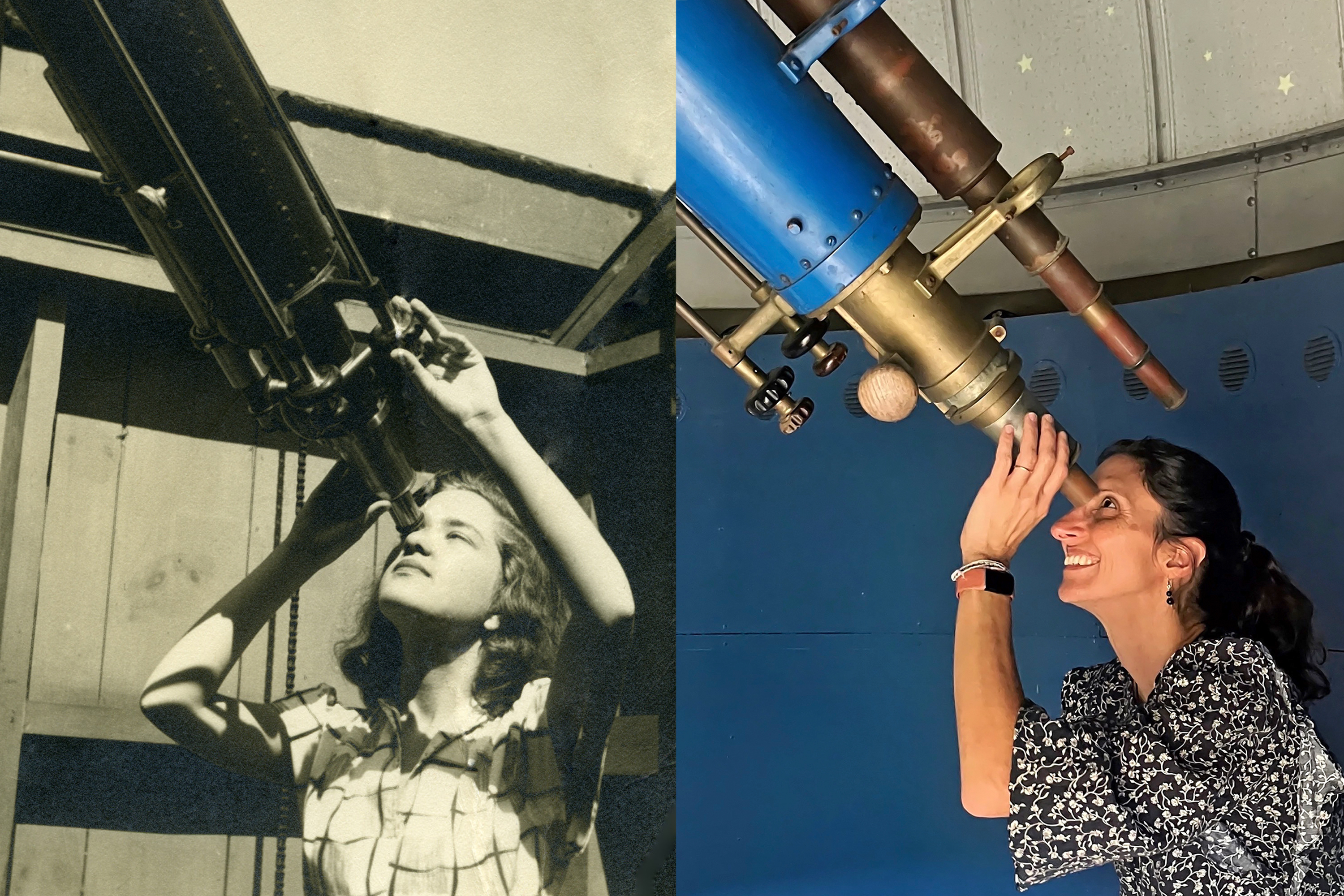
On September 17, Dr. Sandrine Thomas, Associate Director of Summit Operations at the Rubin Observatory, spoke to a packed audience at Vassar’s New England Building. Thomas’s impressive background includes work on the Gemini Observatory’s Planet Imager. An engineering specialist, she joined the Rubin Observatory as the Telescope Project Scientist to ensure that the telescope was built correctly and to coordinate Rubin’s international team of engineers and scientists.
During her talk, Thomas shared information about the Vera C. Rubin Observatory, the first major, publicly funded U.S. observatory named after a woman, which stands atop Cerro Pachón in Chile.
“Rubin became famous for her groundbreaking discovery of dark matter—an invisible mass that causes galaxies to rotate faster than expected, and something that remains unexplained,” said Vassar’s Physics and Astronomy Chair Colette Salyk. “The observatory uses the largest digital camera ever built to detect and study anything in the sky that changes, including stellar explosions, asteroids and comets, and variable stars.”
Thomas said Rubin also wanted to understand how all things moved, “So she would memorize paths of meteors and map their locations. She was interested more in the questions than the answers, and she really advocated for women in astronomy, and that’s how this whole dream came together.”
This year, the observatory launched the Legacy Survey of Space and Time (LSST), a 10-year survey of the sky that Thomas calls “the greatest astronomical movie of all time.”

“The mission of the observatory is to produce unprecedented astronomical data sets for studies of the deep and dynamic universe, and make the data widely accessible to a diverse community of scientists and the general public,” said Thomas. “Some of these studies will be used to better understand the history of the universe.”
Thomas explained that the observatory will scan the entire southern sky every three to four nights for 10 years. “We can detect very faint objects because we have the ground-based Simonyi Survey Telescope, which is the world’s fastest-slewing large telescope,” she said. (In astronomy, “slew” refers to how quickly a telescope moves across the sky.) “It also ships the images to the U.S. facility in California, and then later to France and the U.K., where it does a lot of processing and storage.”
Thomas added that the survey will allow astronomers to study the structure and form of the Milky Way. “The 10-year survey will help us catalog a lot of the Milky Way in an unprecedented fashion. We have a 3D map that’s 100 times larger than previous surveys because we get so much data so fast, and we’ll have a catalog with about 20 billion stars. The catalog will have information on their position and motion within the galaxy, and that’s going to help us understand the evolution of the galaxy, and potentially its formation.” The survey will also allow observers to detect asteroids that might be a threat to Earth.
Another goal is probing dark matter and dark energy. “Only 5 percent of the universe is what we can see and touch,” Thomas said. “[But] 95 percent remains a mystery, and so it is really important for us to understand what it is and how it interacts with the rest of the matter,” she explained.
The initial round of test images was completed in June 2025, and the LSST began its nightly documentation on June 30, 2026. “The telescope documents 20 terabytes of data every night for 10 years and provides alerts when there are changes in the sky,” said Thomas.
On the first night, the observatory issued more than 200 alerts, and over the first 30 days, more than 30,000. More than 40 scientific papers have since been written on the observatory’s findings. By the end of the 10-year survey, observers expect to have captured at least 2 million images.
Looking back at Rubin’s career, it’s clear to Thomas that Rubin’s insights continue to shape the field of astronomy today. One piece of Rubin’s advice in particular sticks in her mind: “Don’t shoot for the stars; we know what’s there. Shoot for the space in between because that’s where the real mystery lies.”
Vera C. Rubin’s effect on the future of astronomy will continue for years to come. She gifted Vassar an endowed fund to cover students’ travel to work at observatories or labs or to present their work at scientific conferences.