New Exhibition at The Frances Lehman Loeb Art Center at Vassar Features Japanese Art from 1830 to 1904 That Documents an Era of Power, Expansion, and Change
The Loeb presents the exhibition Bunmei Kaika: Political Landscape in Early Modern and Modern Japan.
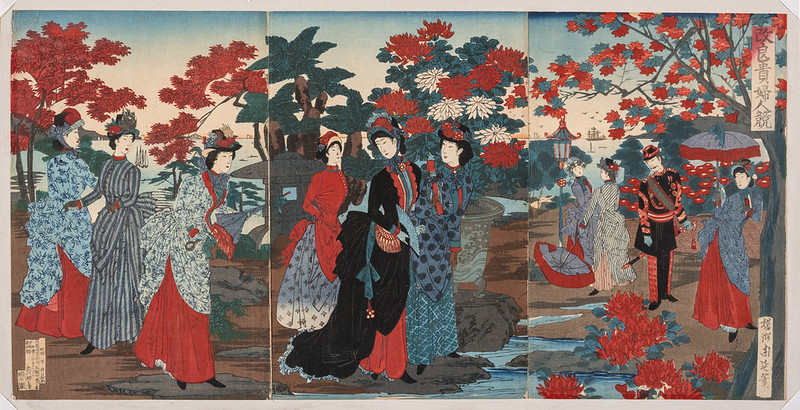
On view February 14, 2026–June 7, 2026, the Bunmei Kaika exhibition examines the drastic shift in Japan’s national identity during the nineteenth and early twentieth centuries. While this was a time of major political and social upheaval for the nation, it was also a time of expansion and modernization. Many artists responded to the shifting political and physical landscape by depicting it in woodblock prints and works on paper. Drawn largely from The Loeb’s permanent collection along with select loans, this exhibition sheds new light on landscapes from celebrated artists such as Hiroshige, Hokusai, Kunisada, Yoshitoshi, Kiyochika, and Ogata Gekkō.
An opening lecture on Saturday, February 28 at 2:00 p.m. by Chelsea Foxwell, University of Chicago Professor of Art History, East Asian Languages and Civilizations, will bring context to the significance of works from this time period. A reception in The Loeb’s atrium will follow at 3:30 p.m.
The exhibition’s title, Bunmei Kaika, meaning “civilization and enlightenment,” explores the impact of the Edo period’s Tokugawa shogunate and the succeeding Meiji period’s government of Imperial Japan on political thought, nation building, and the dissemination of prints, from rural landscapes to urban cityscapes across thematic gallery spaces.
On the Road: Tōkaidō and Beyond contextualizes prints of famous places (meisho-e) of the Edo period within sociopolitical and visual discourse; Philosophy, Religion, and Politics: Urban Planning in Edo explores the role of Neo-Confucianism as an arm of the Tokugawa shogunate within the political landscape through the frameworks of ideology, infrastructure, and place; Religion and Nationalism: Meiji and the Imperial Family’s Image focuses on the relationship between religion and nation building during the Meiji period; A City Transformed: Tokyo introduces civilization pictures (kaika-e), a genre that emerged during the early and mid-Meiji periods in which artists captured dress reform and feats of urban engineering orchestrated by the Meiji government; Sensō-e and the Concept of News: Colonization, Propaganda, and Censorship examines how civilization pictures and war prints (sensō-e) furthered Imperial Japan’s political agenda by simultaneously instilling national pride in its constituents and positioning the nation as an imperial power.
Plan your visit and learn more about the exhibit.
Admission and Hours
Admission to the Frances Lehman Loeb Art Center is free and all galleries are wheelchair accessible. The Loeb is open Tuesday to Sunday (10:00 a.m.–5:00 p.m.) and, from June through August, late nights on Thursdays (5:00–7:00 p.m.). The Loeb is located at 124 Raymond Avenue, near the entrance to the Vassar College campus. Parking is available on Raymond Avenue. Directions to the campus in Poughkeepsie, NY, are available at our visitor information page. The Art Center is also accessible via Dutchess County Public Transit, Bus Route L. For more information, call 845-437-5632 or visit vassar.edu/theloeb.
About The Loeb Art Center
The Frances Lehman Loeb Art Center is a teaching and learning museum, free and open to all, supporting Vassar College’s educational mission and communities. Formerly the Vassar College Art Gallery, The Loeb is the first art museum at a college or university that was part of the institution’s original plan. Today, the permanent collection includes more than 22,000 works, comprising paintings, sculptures, drawings, photographs, textiles, and glass and ceramic wares. The Loeb strives to be a catalyst for scholarly, creative, and social justice work by Vassar students and others. It aims to reflect a commitment to broaden and amplify the voices represented in the museum setting, and to ensure that The Loeb’s programs and practices have a positive impact on campus and beyond. To learn more, please visit vassar.edu/theloeb or follow on Facebook, Instagram and YouTube.
Commitment to DEAI
The Frances Lehman Loeb Art Center at Vassar College commits to Diversity, Equity, Access, and Inclusion (DEAI) as core values across its culture, systems, and practices. We pledge to allocate resources (human and financial) to create and sustain a museum culture in which difference is celebrated. The Loeb staff is dedicated to integrating DEAI priorities into gallery installations, programming, interpretation, collections management, acquisitions, and internal processes. Our ongoing work is guided by an intention to care for all people engaged with the Loeb while welcoming the exchange of ideas, enriching experiences, and diverse perspectives through art.
Land Acknowledgement
We acknowledge that Vassar stands upon the homelands of the Munsee Lenape, Indigenous peoples who have an enduring connection to this place despite being forcibly displaced by European colonization. Munsee Lenape peoples continue today as the Stockbridge–Munsee Community in Wisconsin, the Delaware Tribe and the Delaware Nation in Oklahoma, and the Munsee-Delaware Nation in Ontario. This acknowledgment, however, is insufficient without our reckoning with the reality that every member of the Vassar community since 1861 has benefited from these Native peoples’ displacement, and it is hollow without our efforts to counter the effects of structures that have long enabled—and that still perpetuate—injustice against Indigenous Americans. To that end, we commit to build and sustain relationships with Native communities; to expand opportunities at Vassar for Native students, as well as Native faculty and other employees; and to collaborate with Native nations to know better the Indigenous peoples, past and present, who care for this land.
Vassar College is a coeducational, independent, residential liberal arts college founded in 1861.
Contact
Gabriel Anjo
mediarelations@vassar.edu
(845) 437-7405
Destiny Kearney (Frances Lehman Loeb Art Center)
dkearney@vassar.edu
(845) 437-7125
Photos
Download high-resolution images from the Vassar College Media Relations Flickr site