At Vassar, Actor/Director John Cameron Mitchell Reflects on Art, Freedom, and Risk
“I’m happy to not wear that damn wig today ...” For John Cameron Mitchell—the playwright, actor, director, and famed chronicler of queerness—that was just one reason to take a day off from portraying Mary Todd Lincoln in the hit Broadway play Oh, Mary! The primary reason, however, was to visit Vassar campus to deliver the Capotorto and Mulas Family Lecture in conversation with Associate Professor and Chair of Film Erica Stein.

A winner of multiple Tony, Obie, and Drama Desk awards, Mitchell is best known for creating the iconic 1998 rock musical Hedwig and the Angry Inch, for which he originated the title role. On this sunny Saturday, he took to the stage in Taylor Hall dressed extra comfortably in flowing harem pants and a Marvel Comics t-shirt.
Mitchell, at age 61 a sparkling conversationalist with an arsenal of stories and treasure troves of advice, started from the beginning. He grew up in a military family, a seemingly conservative culture that nonetheless contributed to his worldview. “You were oddly free to do what you wanted,” Mitchell remembered. “We were citizens of the world—we lived in Europe, Asia.”

As a theater student at Northwestern University, Mitchell learned the value of flexibility and versatility in the arts. “We had wonderful professors who told us that all the roles we were playing at Northwestern—writers, directors, designers, actors, scholars—it was all equally important. I did it all there, and continue to.”
Mitchell’s “doing it all” shouldn’t shock anyone who has paid any attention to his career. After establishing himself as a stage actor in New York, Mitchell created Hedwig, penning the tale of a trans East German rock musician striving to reclaim stolen fame, starring in the title role and writing the songs with composer Steven Trask. An off-Broadway sensation, Hedwig was then made into a cult-favorite 2001 film, again starring and directed by Mitchell, who won Best Director at Sundance that year.

Mitchell’s global outlook has been returned by countries around the world. “Hedwig just opened for the first time on stage in mainland China. I’m like, ‘Did they read it?’” he exclaimed, to peals of laughter. “It’s about someone changing their gender ... to escape Communism!” The audience’s laughter turned to applause when Mitchell proudly announced that his notoriously sexually explicit film Shortbus (2006), previously banned in South Korea, had had its ban overturned by the Supreme Court of that nation. “Imagine our Supreme Court having to watch that!”
Indeed, the specter of the American political scene arose frequently in the course of the conversation, with the word “fascism” coming up more than once. Still, Mitchell cautioned students of the arts that repression can come from places other than cultural conservatism. “I’ve met a lot of anxious and depressed kids who were not prepared for where we are now in that their main way of working was to stay politically correct and not rock the boat in any way,” he said. “When that starts to attach to a lot of rule-making, like you can’t say this, you can’t say that, we shoot ourselves in the foot.”
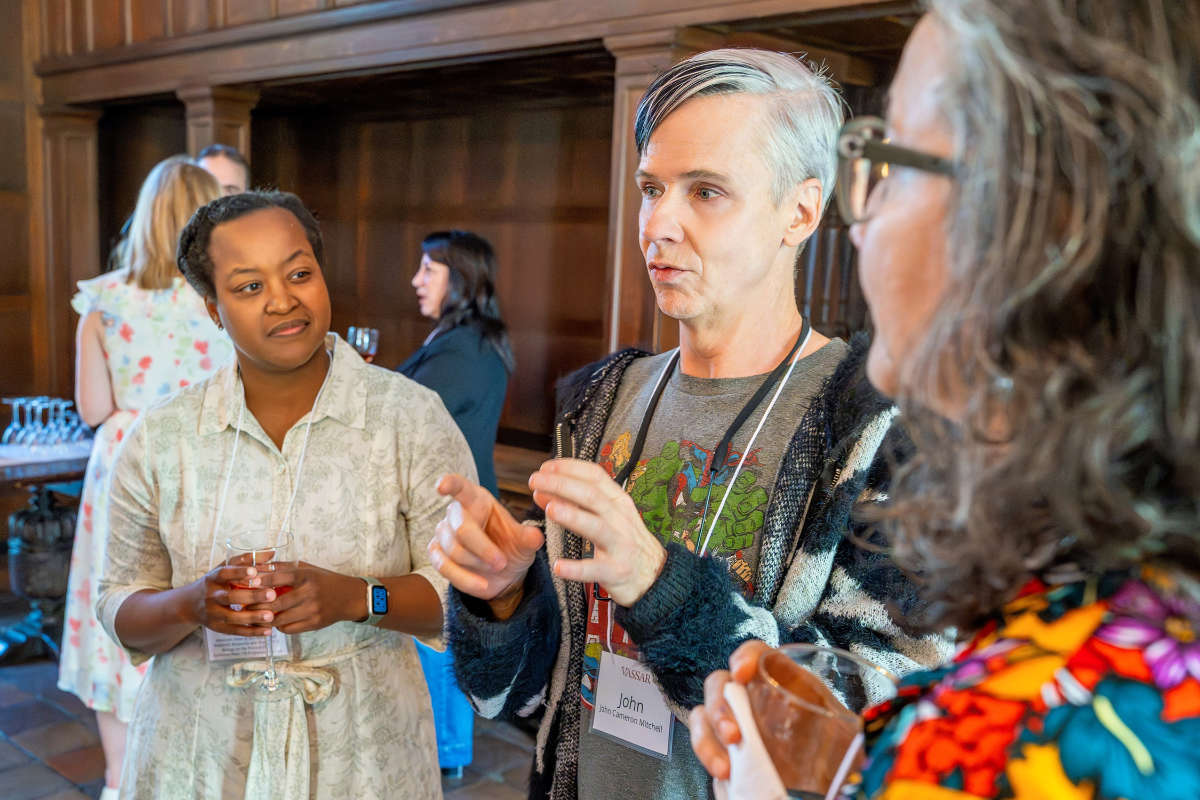
Ultimately, Mitchell’s message was one of hope, empathy, creativity, and generosity. “Connecting people, giving comfort, lighting a fire under someone’s ass to make their own thing” are what it’s all about for Mitchell, who also reminded the appreciative crowd that art is best made outside of commercialism, by those whom the industry ignores. “When you can’t sell out,” he counseled, “something special happens.”