
Rooted in Community: Tending Vassar’s Living Legacy
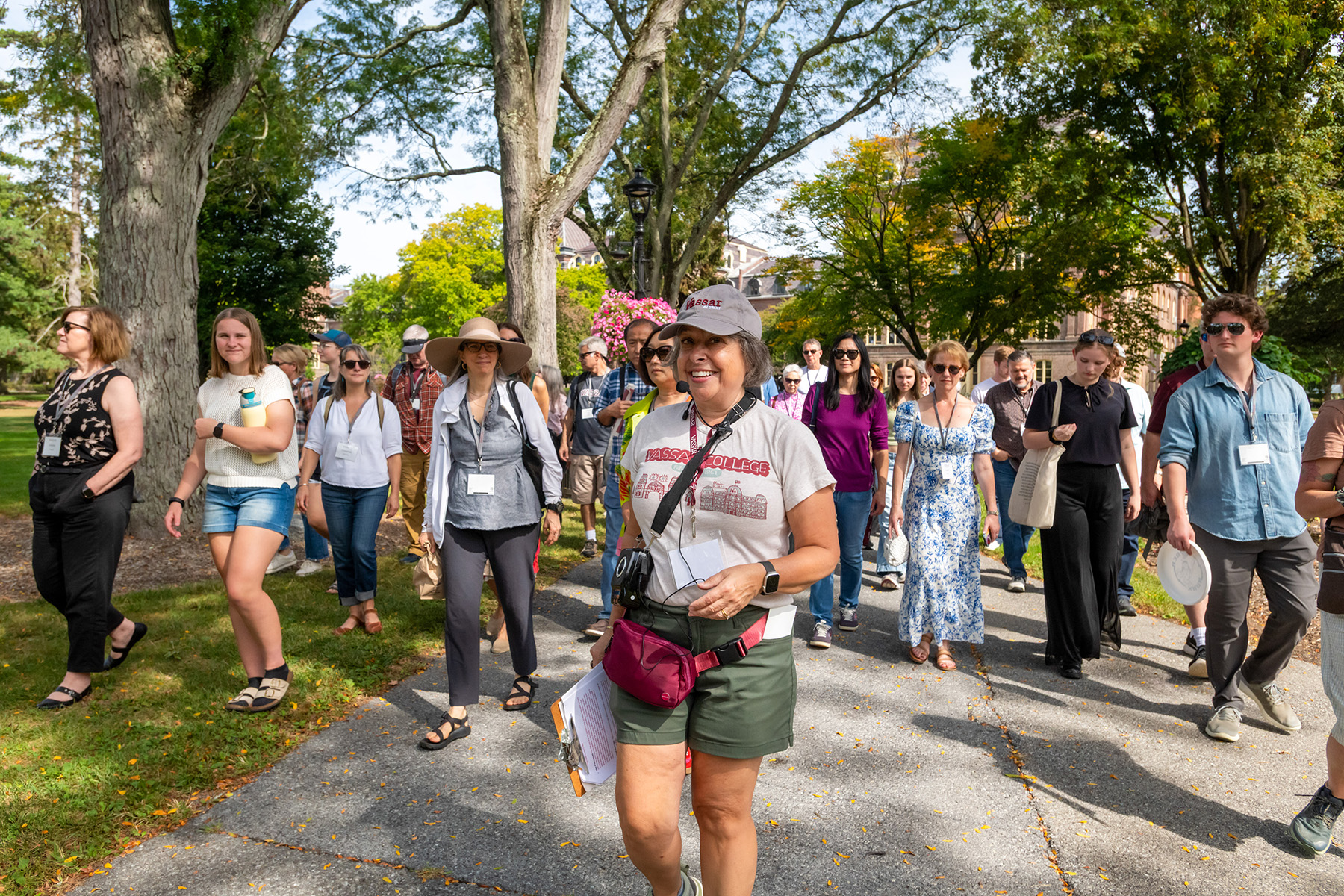
On Reunion weekend, a crowd gathers beneath the canopy of trees near Main Building, standing under the branches that have stretched over generations of students. At the front of the group is Laura Graceffa ’87 and her spouse, retired Vassar biology professor Mark Schlessman, who lead Arboretum tours during Reunion and for Families Weekend.
The tour group pauses at familiar landmarks—the ginkgo behind Main, the London planetree in front of Thompson Library, and the class trees planted across Vassar by students decades apart. What began as a way for the couple to share the campus’s botanical history has become something more personal: a return to the living landmarks that shaped so many alum and student experiences.
“The number of people who come on these tours during those weekends is humbling,” Graceffa said. “Both tours are a celebration of community.”
For many in the Vassar community, the trees they passed on their way to class, on late-night walks, and through changing seasons are still standing when they return for Reunion years later. For Graceffa and Schlessman, the trees represent not only continuity but responsibility.
Schlessman received his PhD from the University of Washington, Seattle, and came to Vassar in 1980 as a botanist and professor. When he learned the campus was an arboretum, he was ecstatic, acknowledging its use as a teaching resource but also its environmental impact. Throughout his time at Vassar, Schlessman became one of the Arboretum’s most dedicated stewards, including establishing the Campus Arboretum Committee to ensure the long-term health of the collection. Today, the committee guides decisions affecting the campus’s tree population and arranges class tree plantings.
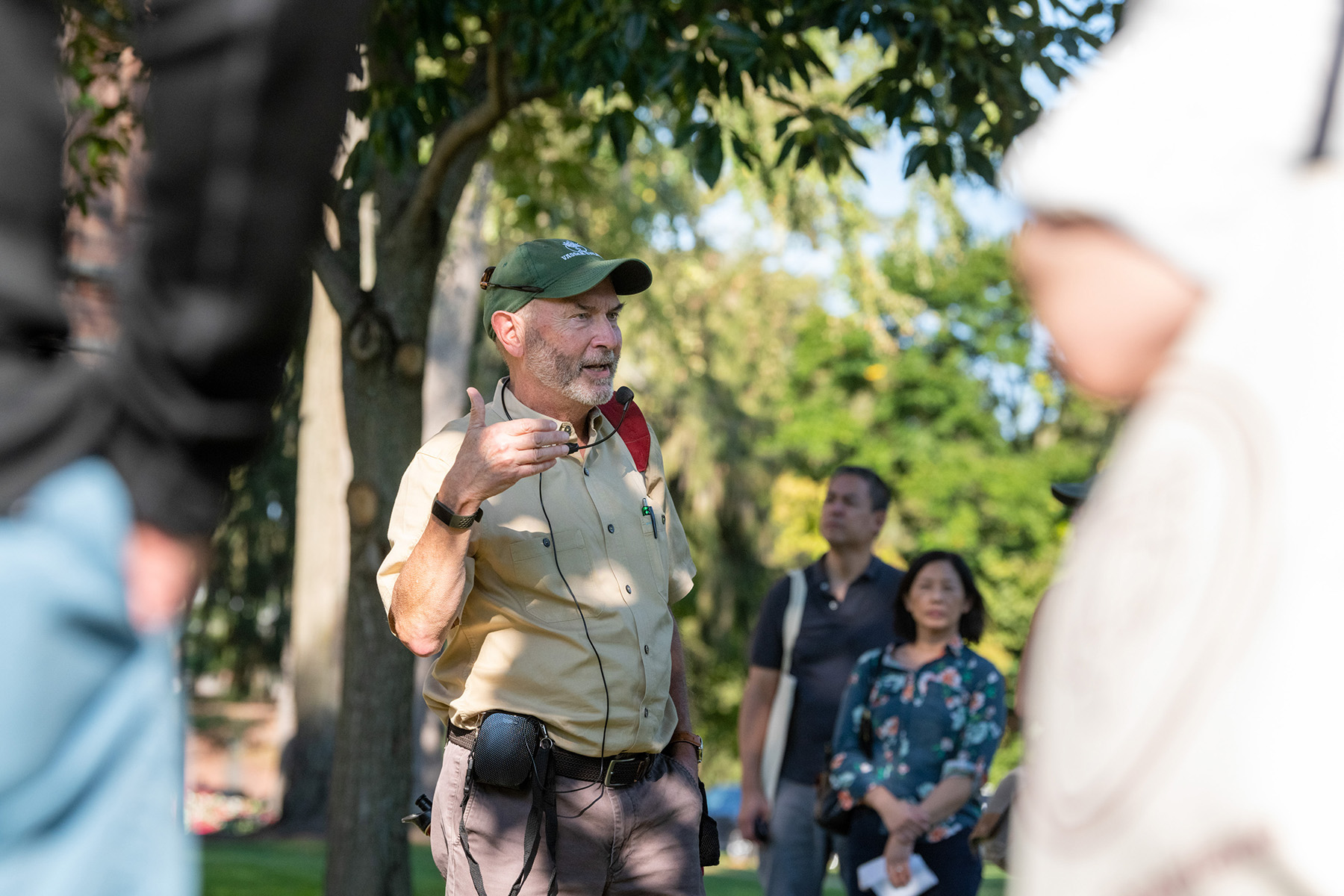
In 2018, Schlessman started leading Arboretum tours for alums during Reunion weekend and later, due to the tours’ success, added Families Weekend. He has continued leading both tours even though he retired in 2022.
For Graceffa, who graduated with a biology degree in 1987, the campus’s trees impacted her before she had officially enrolled. Growing up in New Hampshire, surrounded by the beauty of the natural world, she found inspiration during a return visit to campus, with a special affinity for the ginkgo tree behind Main Building. She went on to receive degrees in education and science from Brown University and taught at Poughkeepsie Day School. She eventually became the head of its middle school, and then Head of School at Robert C. Parker School near Albany.
For Graceffa’s 35th Reunion, the pair decided to lead the Reunion tour together, teaming up with the AAVC to mark the Reunion class trees with garden flags and arrange the tours to stop at each one. “The class tree flags grab people’s attention, and even alums who aren’t aware that they have a class tree become eager to find theirs and learn more about it,” Graceffa said.
The alum-emeritus pairing has also worked for Families Weekend. “We manage to work in a fair amount of interesting botany, and alums and parents alike love hearing about the class tree tradition origin, the iconic ‘Vassar Sycamore,’ and other tree lore,” Schlessman said.
The trees on Vassar’s campus are a part of the College’s story, rooted in its earliest days, when Matthew Vassar supervised plantings, and strengthened in 1925 when landscape architect Beatrix Ferrand secured its recognition as an arboretum. Today, Vassar’s Arboretum is home to more than 2,600 trees representing over 170 species.
In 2020, thanks in part to Schlessman’s efforts, the campus was officially accredited as an ArbNet Level II Arboretum. He also helped revitalize the class tree tradition, the second-oldest tradition on campus, after Convocation. When Graceffa was a student, the tradition had largely fallen by the wayside, with little fanfare. During that time, class trees were often selected during senior year, and students were expected to fundraise to secure their own planting.
Today, class trees are planted during sophomore year, giving students time to watch it grow alongside them as a living marker of their class long before they cross the Commencement stage.
After years of shaping the stewardship of Vassar’s landscape, the couple recently created a new endowment to support the Arboretum and the class tree tradition. They timed their gift to coincide with the collection’s 100th anniversary, which was marked by a campuswide celebration on Arbor Day 2025 and events throughout the year.
“We wanted to do what we could to make sure the tradition lasts,” said Schlessman.
For Graceffa, the landscape itself has always been a teacher. “As an educator, we call your landscape and surroundings the ‘third teacher,’” she said. “We acknowledge that space and say, ‘Where you’re learning, it’s having an influence on you.’”
Their gift ensures that the Arboretum and the traditions rooted within will continue to enhance the lives of generations of Vassar students long after individual classes or faculty members have moved on. In recognition of their many contributions, the Office of Sustainability will plant a tree in honor of Graceffa and Schlessman this spring, adding another chapter to the living story they have spent decades helping to preserve.
Learn more about the Vassar College Arboretum at vassar.edu/arboretum. To make a gift to the Laura Graceffa and Mark Schlessman Class Tree and Arboretum Engagement Fund, email Karolina Gomez, Associate Director of Annual Giving and Digital Engagement Officer, at kgomez@vassar.edu.