
New Book by Vassar Professor Reveals How White Nationalists Are Co-Opting the Classics
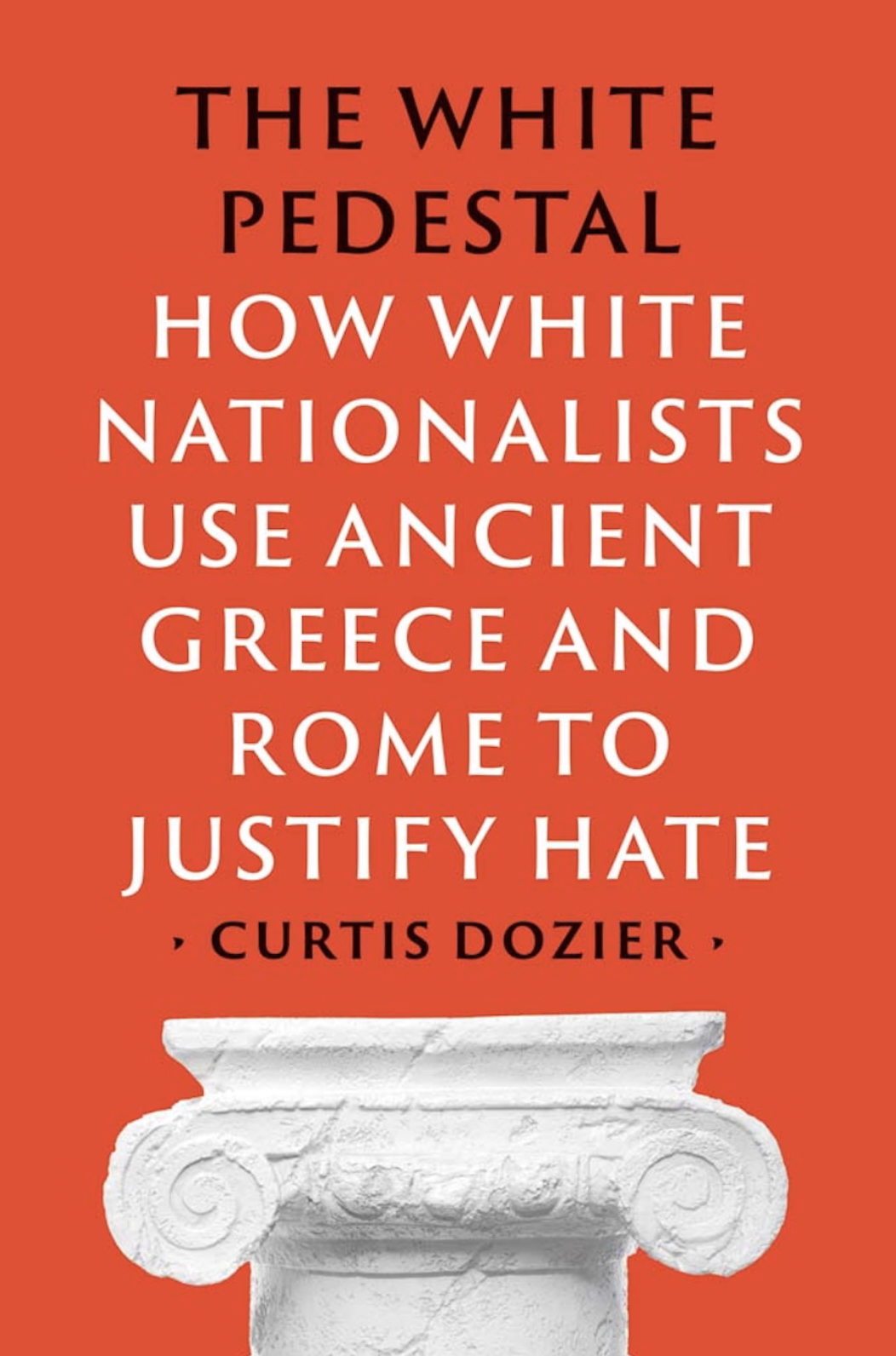
The White Pedestal: How White Nationalists Use Ancient Greece and Rome to Justify Hate, a new book by Associate Professor and Chair of Greek and Roman Studies Curtis Dozier, grew out of a very Vassar “go to the source” kind of project.
Dozier and his students were investigating the appearance of the Parthenon in the logo of a notorious neo-Nazi website. What they found when they waded into this online world was shocking: Some of the most revered ancient thinkers actually did have views very much in line with white supremacist ideology, and an uncritical admiration for Greco-Roman antiquity in American culture was helping the white nationalist movement gather momentum. “It is exciting to challenge long-held beliefs that serve violence,” explains Dozier. “Being critical is a form of love.” Dozier offers a preview of his findings in this Q&A.

Americans encounter references to ancient Greece and Rome everywhere—from the architecture of government buildings to Gladiator movies. Is the portrayal of Greco-Roman civilization in American popular culture truthful?
Both popular and institutional representations of Greco-Roman antiquity are idealizing. They curate an image of the ancient world as a source of high-minded political ideals like freedom, rationality, and democracy. And as always, there’s much more to history than those idealizing narratives of it. Classical Athens is often called “the birthplace of democracy.” But the way democracy was practiced in Athens would not look very democratic to us; the most notorious and well-known feature of the Athenian democracy was the exclusion of women from civic rights. And it was a slave economy, of course. The list goes on and on of ways that it doesn’t look very democratic. And in fact, that’s why the people I wrote my book about, the white nationalist activists, are very interested in Athens as a model. They see the ancient world as a source of prestige and legitimacy for violent and oppressive ideas.
Are you saying that most of the people in these movements who use a classical bust as their profile picture actually know this? Are they more educated than the average American about how these societies really functioned?
I don’t know if I’m prepared to say that most people in the movements are more educated than the average American. But the people that I wrote my book about are a subset of white nationalist activists who are much more educated about the ancient world than most people. A lot of them have PhDs in political science or philosophy or other advanced degrees. Sometimes I actually think they see the ancient world more clearly than professional historians do. And they recognize in it a very fruitful rhetorical field for promoting their politics. This is why a big thing I’m trying to do in my book is challenge the idea that white supremacists and racist and white nationalist intellectuals must be distorting history if they use it in their rhetoric around white nationalist politics.
What led you to take on this project?
When, in 2016 and 2017, the white nationalist movement was getting a lot of national media attention, a lot of classical scholars noticed that these activists were very interested in the classical world. [White nationalist leader] Richard Spencer was saying that the United States should become an all-white ethnostate, calling it “a new Roman empire.” And in 2017 at the Unite the Right rally in Charlottesville, Virginia, where demonstrators chanted openly white nationalist slogans like “Jews will not replace us,” there was a classical symbol in the promotional poster for that rally. The teaching I had done at Vassar prepared me to recognize that as an interesting “reception” [meaning an adaptation or reimagining for a different historical time period]. So that’s when I decided to do something with it: I launched my website, Pharos: Doing Justice to the Classics, in 2017 to document examples of hate groups online using ancient Greece and Rome. I’ve had 12 undergraduate research assistants working with me on it over the years, and every single page on that website is better for their involvement; it was very helpful to have their critical perspective to help me develop my critical perspective. The site couldn’t exist without them, and my book couldn’t exist without them, because working on that site for the last eight years was really the preliminary research that went into writing it.
Was there anything in the course of your research that surprised you?
Oh, the entire thing surprised me because I think when I started, I believed that my job as a scholar was to show that the hate groups using ancient Greece and Rome were distorting the ancient past and to resist them by pointing out their errors. And I did do that on the site—it’s easy to find examples of white nationalist actors who have a superficial or wrong understanding of ancient sources. But the more I worked on it, the more I started encountering the group of intellectuals who are the subject of my book—who knew that they didn’t need to distort ancient history to support their politics; who knew there were plenty of authentic quotes from ancient authors that were either articulating white nationalist ideas or congenial to them.
For example, Aristotle in his Politics argues that there are some people who are just meant to be enslaved, that by nature they should be enslaved to the type of person who, by nature, should be the master over them. Plato has a character in The Republic say that deformed infants should be taken away and put in a dark place. The Roman geographer Strabo says that wherever Jewish people go, they install themselves and take power. The Roman historian Sallust basically says that sexual immorality led to the decline of the Roman aristocracy and thereby the decline of the Roman Republic. All of this is very suitable for white supremacist, transphobic, homophobic, misogynist, pro-eugenics, anti-Semitic—any kind of white nationalist or neofascist idea.
I imagine that you’re going to have to fend off critics who say that, in writing this book, you are trying to “cancel” the ancient world. How do you respond to that?
Yeah, I do hear that from colleagues occasionally. They say, “Aren’t you worried about driving students away from the study of the ancient world at a time when already the humanities are under such threat?” That has not been my experience at Vassar: Students here are energized and fascinated to learn the ways that the ancient world is used by hate groups. It shows them that studying history has stakes, that history matters. Being on the side of justice means telling the truth about history and about what’s happening now. And, yes, I think the ancient world needs to be less respected. It needs to be viewed more critically. My book is called The White Pedestal because the ancient world has been placed on this pedestal, a racialized pedestal, a white supremacist pedestal, and it needs to be knocked off. Because, ultimately, the way we weaken the appeal of the ancient world for white nationalist activists is to make it less rhetorically useful for them. The more people who understand that there are a lot of hateful ideas in the ancient world, along with many ideas we might wish to idealize and admire, the less useful the ancient world is going to be for these hateful political movements. That’s the goal that I’m trying to participate in as a classical scholar—a project of disrupting and weakening white supremacy in this country. And if there’s a cost to the prestige of my discipline, then so be it.