
In a New Book, Professor Taneisha Means Explores the Lives, Work, and Impact of Black Judges
When Associate Professor of Political Science Taneisha Means was an undergraduate at John Carroll University in suburban Cleveland in 2009, she was pulled over by police one evening for accidentally driving without her headlights on. Means had no way of knowing that this incident would trigger the trajectory of much of her academic research.

Means went to court to contest the $200 ticket, assuming the judge would be a white man, since white men comprise the vast majority of judgeships nationwide. Instead, Means was surprised to see an older Black woman judge presiding in the courtroom. The judge listened to Means’ explanation for driving without her headlights on, noting she had neglected to notice this oversight because she was near downtown Cleveland, where the streets were well-lit.
“The judge actually listened to me and could tell I was shaken up by the experience,” Means said. “She agreed that being issued a ticket was excessive and said I should have received a warning instead. She spoke to me as another human being, not just as a defendant in a courtroom.”
When Means enrolled at Duke University for graduate school, her experience in that Ohio courtroom prompted her to pursue research on Black political representation in the courts, especially the lives, work, and impact of Black judges in the United States. That research continued when she joined the Vassar faculty, and she wrote a book on the subject—Robed Representatives: How Black Judges Advocate in American Courts, published this month by Stanford University Press.
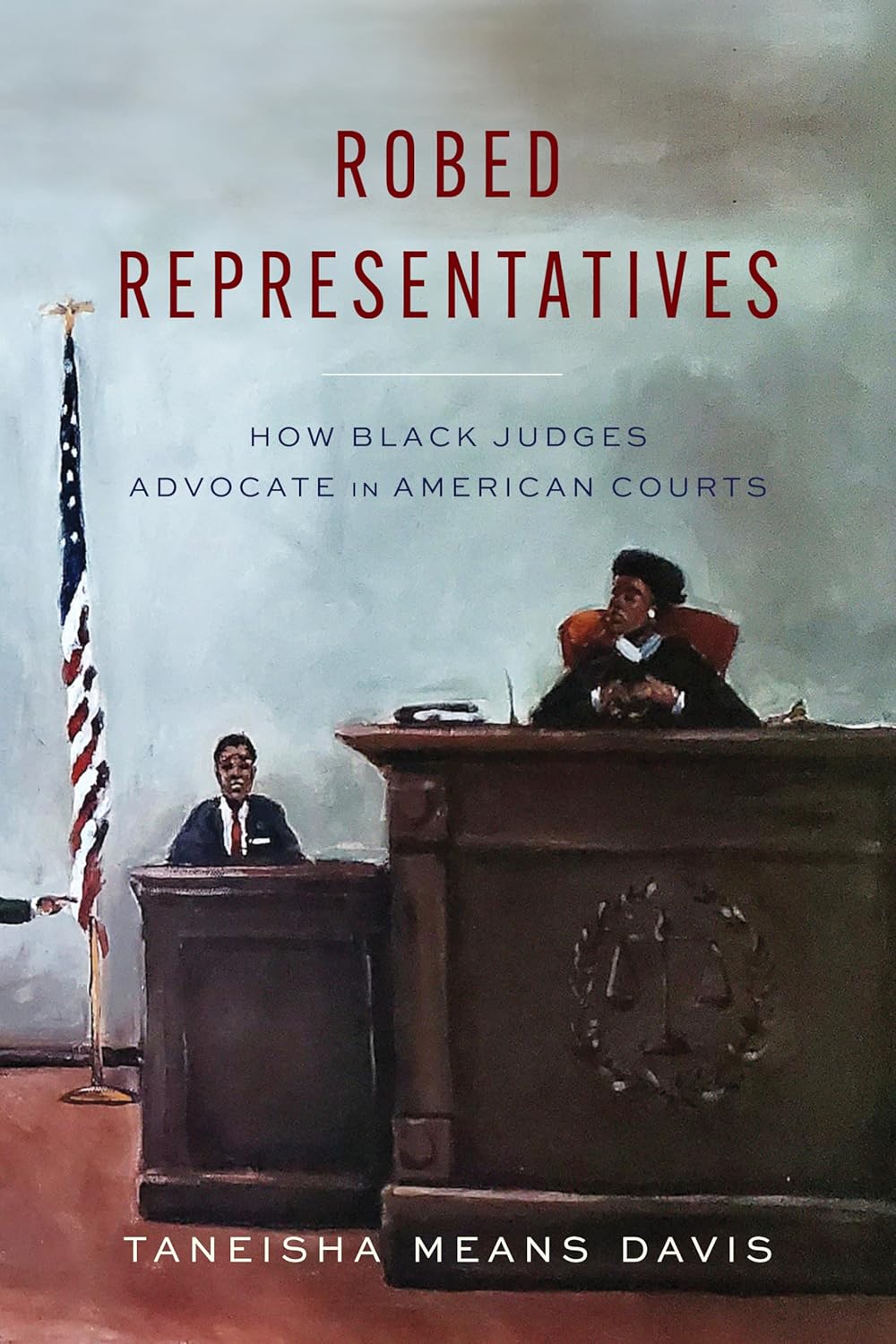
Means said more than a dozen Vassar students had taken part in research on the topic, mainly funded through a National Science Foundation grant and Vassar’s Ford and Creative Arts Across Disciplines Programs. “These students constructed instruments to collect data and surveyed judges through emails and interviews,” she said. “They truly contributed to this project.”
Means said she had taken college courses that touched on the careers of such legal superstars as Supreme Court Justice Thurgood Marshall and one of his law clerks, civil rights attorney Constance Baker Motley, who later became the first Black woman federal judge. “But I wanted to investigate the roles of state and local Black judges, because they engage with and touch more people in their everyday lives,” Means explained. “My book is about these judges and how important they are to the justice system.”
Her theory of “advocative representation” is intended to explain how and why political actors who are neither expected to nor charged with representing group interests might still do so. Means said her research showed that Black judges don’t give “special treatment” to any group but rather are more likely to assess the human side of the equation with all defendants that appear before them, “as that first Black judge I encountered had done for me in 2009.” Judges have wide discretion in deciding cases, and Black judges consider a broad range of factors, often based on their own experiences, she noted.
The number of Black judges has grown significantly in recent decades, but they remain underrepresented relative to the general Black U.S. population. While the percentage of Black Americans in the U.S. is around 14 to 15 percent, Black judges comprise less than 10 percent of state judgeships. They are better represented in the federal judiciary (14 percent). “The federal courts have been infused with more Black judges with appointments by Presidents Barack Obama and Joe Biden over the last 20 years, but the trend first began in 1977 with Jimmy Carter,” Means said.
In 2022, Biden appointed Ketanji Brown Jackson, the first Black woman to serve on the U.S. Supreme Court. “Biden felt the bench should ‘look like the country’ and that it was ‘long past time’ to have a Black woman on the highest court in the nation, given its more than 230-year existence,” Means writes in her book.
Means also wrote about another groundbreaking judge, Poughkeepsie native Jane Bolin, who was the first Black woman in the United States to join the judiciary when New York City Mayor Fiorello LaGuardia appointed her to the city’s Domestic Relations Court, now known as Family Court, in 1939. Means said she hopes to organize an annual event in Poughkeepsie honoring Judge Bolin and will advocate for having her story become a more prominent part of what we celebrate locally and teach local youth.
Means said she hopes her book is read not just by scholars interested in the subject but by other members of the public, including young Black men and women who aspire to enter the legal profession. “Black judges are absolutely making the system better, and this book highlights the importance of judicial diversity—why this matters. Such a book is important always, but especially right now as there is a political current that is actively trying to end DEI, stifle Black political representation, and erase Black historical and contemporary social and political contributions,” she said.