Matthew Schultz
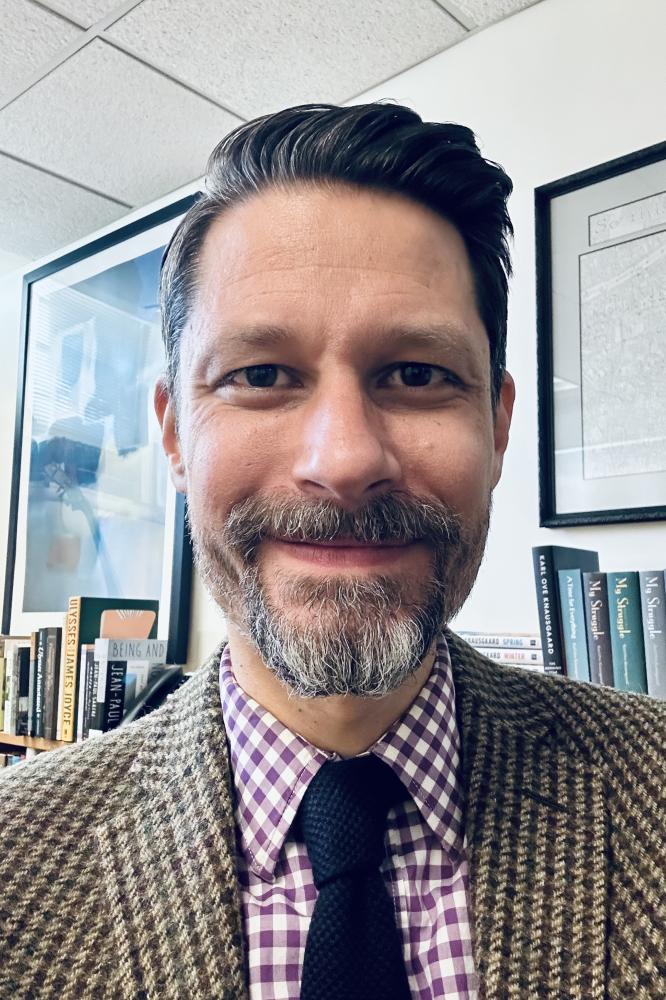
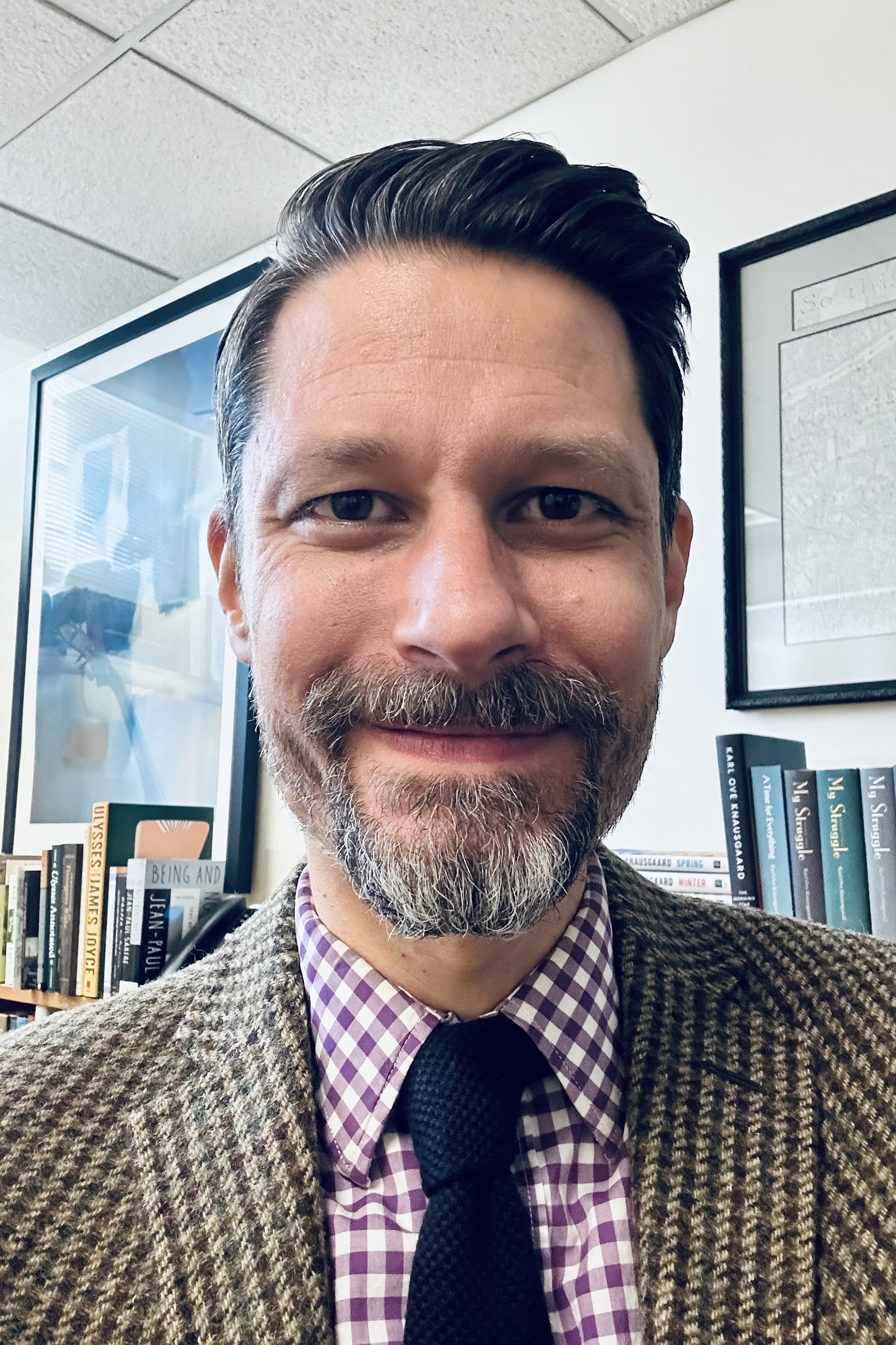
Matthew Schultz earned his B.A. and M.A. in English Literature from John Carroll University and his Ph.D. in English Literature from Saint Louis University, where he specialized in Irish Studies, literary modernism, and postcolonial theory. His teaching and scholarship explore how literature, media, and cultural forms preserve ways of knowing that modernity often disciplines, marginalizes, or forgets. His courses ask students to read poems, novels, plays, films, games, and other artifacts as active forms of perception that shape belief, carry memory, and organize historical inheritance. Whether teaching the Irish Literary Renaissance, speculative fiction, or creative writing, he emphasizes slow attention, interpretive patience, conversation, revision, and imagination as a disciplined way of knowing. Across his courses, Dr. Schultz returns to questions of belief, cultural inheritance, mediation, and imagination, inviting students to ask how the past remains active in the present, how forms travel across genres, media, and historical periods, and how literature helps us read the worlds we inherit.
Matthew Schultz earned his B.A. and M.A. in English Literature from John Carroll University and his Ph.D. in English Literature from Saint Louis University, where he specialized in Irish Studies, literary modernism, and postcolonial theory. His teaching and scholarship explore how literature, media, and cultural forms preserve ways of knowing that modernity often disciplines, marginalizes, or forgets. His courses ask students to read poems, novels, plays, films, games, and other artifacts as active forms of perception that shape belief, carry memory, and organize historical inheritance. Whether teaching the Irish Literary Renaissance, speculative fiction, or creative writing, he emphasizes slow attention, interpretive patience, conversation, revision, and imagination as a disciplined way of knowing. Across his courses, Dr. Schultz returns to questions of belief, cultural inheritance, mediation, and imagination, inviting students to ask how the past remains active in the present, how forms travel across genres, media, and historical periods, and how literature helps us read the worlds we inherit.
Dr. Schultz’s research grows out of his teaching on the afterlives of nineteenth- and early-twentieth-century symbolic systems: Gothic forms, national mythologies, and modernist experiments in consciousness. He is especially interested in how these inheritances survive modernization by changing form. His first book, Haunted Historiographies: The Rhetoric of Ideology in Postcolonial Irish Fiction, argues that Celtic Tiger-era Irish fiction revisits the partisan architecture of Ireland’s founding mythologies through the figure of the ghost. Reading novels that return to the Great Famine, the Irish Revolution, World War II, and the Northern Irish Troubles, Dr. Schultz shows how spectrality functions not simply as a Gothic device but as a way of exposing how national histories are constructed, contested, and revised. Similarly, Joycean Arcana: Ulysses and the Tarot de Marseille argues that James Joyce's Ulysses emerges from a culture saturated with Hermeticism, Catholic symbolism, and esoteric theories of consciousness. Rather than treating these traditions as marginal curiosities, the book situates Joyce's experiments with perception and language within a broader culture of competing ways of knowing, revealing modernism not as the disappearance of belief but as its transformation into new aesthetic forms.
His current projects explore the transition from nineteenth-century religious and symbolic cultures to modernist and postmodernist forms of perception. In work on Arthur Conan Doyle, Bram Stoker, Oscar Wilde, and James Joyce, he considers how these inheritances survive modernization by changing form and continuing to shape the epistemological habits through which people encounter the world. In related work on Joyce and H. P. Lovecraft, he examines modernism as a literature of renewed attention, in which signs, dreams, and objects act with strange force in a supposedly disenchanted world.
Schultz is also the author of two novels and multiple collections of poetry, including We, The Wanted; Icaros, and An Oblique Voice. These projects extend his scholarly preoccupation with imaginative forms, tracing the intersections among memory and abstraction, image and language, place and inheritance, the known and the unknown.
Research and Academic Interests
Irish Studies, Literary Modernism, Speculative Fiction, Genre and Media Studies, Creative Writing, Composition & Rhetoric.
Departments and Programs
Courses
ENGL 101, The Art of Reading and Writing
ENGL 205, Introductory Creative Writing
Selected Publications
Books
2025
Pipe Smoke: Poems (Bottlecap Press)
2024
An Oblique Voice: Poems (Bottlecap Press)
2022
Icaros: Prose Poems (ELJ Publications)
With Ghosts: A Mixed-Media Memoir (ELJ Publications)
Inflorescence: Poems (Alien Buddha Press)
Encomium: Cento Paradelles (Beir Bua Press)
2021
Parallax (2River Press Chapbook Series, number 29).
We, The Wanted: An Illuminated Gothic Novel (John Hunt Publishing)
2020
Postcolonial Star Wars: Essays on Empire and Rebellion in a Galaxy Far, Far Away (Editor)
(Cambridge Scholars Publishing)
Joycean Arcana: Ulysses and the Tarot de Marseille (EyeCorner Press)
2015
On Coventry: A Novel (Harvard Square Editions)
2014
Haunted Historiographies: The Rhetoric of Ideology in Postcolonial Irish Fiction
(Manchester University Press); Reviewed in James Joyce Quarterly 52.1 (2014).
Articles and Chapters
2018
“Molly Bloom’s Nostalgic Reverie: A Phenomenology of Modernist Longing.” Irish Studies Review 26.4 (2018): 472-487.
2017
“Revenant Modernisms and the Recurrence of Literary History.” International Journal of English Studies 17.1 (2017): 1-15.
2015
“On Bloodborne’s Impenetrable Darkness: A Modernist Aesthetic” www.whyweplay.org
2014
“Teaching Multimodal Short Fiction: A Supernatural Gothic Tale.” Eureka Studies in Teaching Short Fiction 11/12.
2013
“Recalibrating an Established Writing Center: From Supplementary Service to Academic Discipline.” The Writing Lab Newsletter 37.9-10 (May/June. 2013): 1-5.
“Irish L’humour Noir: Peter Foott’s The Carpenter and His Clumsy Wife.” ABEI Journal 15 (2013): 111-121.
2012
“‘Arise, Sir Ghostus!’: Textual Spectrality and Finnegans Wake.” James Joyce Quarterly 49.2 (Winter 2012): 115-129.
“Narratives of Dispossession: The Persistence of Famine in Postcolonial Ireland.” Postcolonial Text 7.2 (2012): 1-19.
2011
“‘Give it Welcome’: Gothic Inheritance and the Troubles in Contemporary Irish Fiction.” The Irish Journal of Gothic and Horror Studies 10 (Oct. 2011). http://irishgothichorrorjournal.homestead.com
2010
“Synch or Swim: (Re)Assessing Asynchronous Online Writing Labs.” Praxis: A Writing Center Journal 8.1 (Fall 2010). http://projects.uwc.utexas.edu/praxis/
Nominated for the International Writing Center Association Best Article of 2010 Award
“Investing Tutors in the Future of Writing Center Theory and Practice.” The Dangling Modifier 16.2 (Spring 2010). http://php.scripts.psu.edu/dept/ulc/Dangling_Modifier/index.php
“Toward a More Hybrid Discourse: Re-Evaluating (NNS) Client/Consultant Relationships.” Praxis: A Writing Center Journal 7.2 (Spring 2010). http://projects.uwc.utexas.edu/praxis/
2009
“Irish Neutrality: Louis MacNeice’s Poetic Politics at the Outset of ‘The Emergency.’” ABEI Journal: The Brazilian Journal of Irish Studies 11 (2009): 165-182.
“Coalescing Oscar Wilde: Discussing Wilde’s Decadent Aesthetics Using His Essays, Fairy Tales, and Biography.” Eureka Studies in Teaching Short Fiction 9.2 (2009): 79-88.
2008
“Aestheticism in the Poetry of W.B. Yeats: The Two Byzantium Poems.” Literature and Aesthetics 18.2 (2008): 229-250.
“Ritual Storytelling: Confessional Rhetoric in Synge, Yeats, and Joyce.” James Joyce Journal 14.2 (2008): 185-203.
“Intimate Rivalries: ‘A Love that Dare Not Speak Its Name’ in Joyce’s Exiles.” Hypermedia Joyce Studies 9.2 (2008). http://hjs.ff.cuni.cz/
“Künstlerpoetic Travel Narrative: Self-Narration and the Writing Process in George Bilgere’s ‘Cordell.’” The Explicator 67.1 (2008): 19-22.
2007
“The Multiple Contexts of Joyce: Why New Historicism Works.” Eureka Studies in Teaching Short Fiction 7.2 (2007): 119-123.
Reviews
“Exiles: A Critical Edition by James Joyce. Edited by A. Nicholas Fargnoli and Michael Patrick
Gillespie. Gainesville: University Press of Florida, 2016. Irish Studies Review 25.2 (2017): 273-274.
“The Philosophy of Martin Scorsese by Mark T. Conard, Ed.” Film Criticism 33.1 (2008): 80-84.
“Ireland: Space, Text, Time by Liam Harte, Yvonne Whelan, and Patrick Crotty, Eds.” James Joyce Quarterly 44.4 (2007): 829-831.
Grants, Fellowships, Honors, Awards
2022
Teagle/NEH Grant, First-Year Writing Seminar Development (co-director)
2019
Tatlock Fund Endowment Publication Grant for Joycean Arcana
Carolyn Grant Endowment Award, “Interpretive Storytelling and the Tarot de Marseille”
2018
Tatlock Fund Endowment Publication Grant for We, The Wanted
2016
Frances Fergusson Faculty Teaching with Technology Exploration Grant
2015
Tatlock Fund Endowment Publication Grant for On Coventry
2014
Presidential Leadership Grant, Andrew W. Mellon Foundation (Awarded to the FWS Program)
2012
The Susan Turner Fund Endowment Research Grant for Haunted Historiographies
2011
Humanities and Technology Fellowship from the Center for History and New Media at George Mason University and the Andrew W. Mellon Foundation.
Vassar College Faculty Research Conversations Grant
Frances Fergusson Faculty Teaching with Technology Exploration Grant
Alpha Sigma Nu: The Honor Society of Jesuit Institutions of Higher Education
2010
Walter J. Ong, S.J. Award for Excellence in Research from Saint Louis University
Lucien Fournier Award for Teaching Excellence from Saint Louis University
Saint Louis University Pre-doctoral Teaching Fellowship
2009
Saint Louis University Course Development Grant: ENGL–404, “Writing Pedagogy in a Multimodal
World”