
Above Average Capabilities, Below Average Opportunities: Commencement 2002
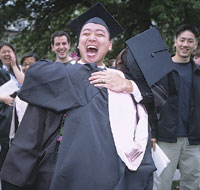
Despite celebration and ceremony, commencement is, for many, a bittersweet affair. It first congratulates seniors on their achievements at Vassar, then thrusts them (most of them, anyway) into a new phase of adulthood requiring financial autonomy and the responsibility of finding a career.
Entering this new phase, the Vassar class of 2002 faces the toughest U.S. job market in over a decade. The national unemployment rate hovers around six percent, and, to make things worse, the National Association of Colleges and Employers estimates hiring of new graduates is down 36 percent from 2001.
A recent U.S. News & World Report cover story urged job seekers to think creatively and consider careers in the federal government, including the burgeoning security industry.
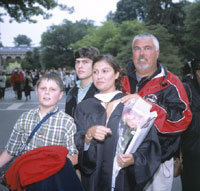
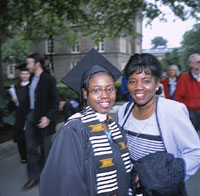
Hannah Dominick ’02 said she thought seniors were aware of the job market but remained optimistic. “There’s this joke [among seniors] that the economy’s so bad, everybody should just go to grad school instead of trying to find jobs. But,” she laughed, “I don’t know many people who are going to grad school, and I don’t know many people with jobs, either.” Her plan (a common one) was to travel during the summer, then return home to consider the next step. Beneath their excitement, many seniors also expressed fears about graduating. These ranged from understandable anxiety about not finding jobs, to worries about not living up to parents’ expectations, drifting apart from friends, or losing structure in their lives. Even the most carefree seniors seemed to realize that in addition to an occupation change, graduation would mean farewell to home, school, friends, and teachers — all in one day.

Dorothy Church Zaring ’32, Beatrice Chinnock Grabbe ’32, and Laura Wood Roper ’32 all took first jobs in Manhattan department stores. Zaring’s stint lasted only three weeks before she found a position as a letter writer through a Vassar-sponsored employment agency. Later, her Vassar Italian courses landed her a job in military intelligence (researching Italy during WWII), leading to a career in Washington. Grabbe’s retail job was comfortable; she knew someone at Macy’s and was hired there as a service supervisor. But Roper was a Macy’s sales clerk and said she was “mercifully fired.” In her next job at Saks Fifth Avenue, she aced a mandatory intelligence test, but after squeezing a customer into a too-small garment, was told that hers “was not a merchandising intelligence.” The supervisor was right: she would later author four biographies.
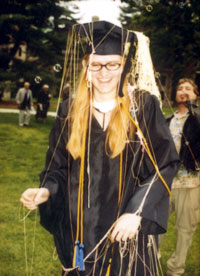
Writer Paul Roberts ’92 said his biggest suggestion for new graduates, one he wished he’d taken himself, is to “recognize that life is a marathon and not a 50-yard dash.” He advises grads to “take the time to really sit down and figure out what type of a person you are and what type of work matters to you, then look for jobs that have those qualities.” He emphasized that this process may take a while.
If 1992 was a bad time to find a job, 2002 has been characterized as a bad time for just about everything. This year’s commencement speaker, Pulitzer-prize-winning playwright Tony Kushner, wryly called 2001–02 “the worst year ever in the history of humankind.” His assessment may strike a chord with recent graduates who’ve had to juggle large-scale issues such as terrorism and mass destruction on one hand and personal concerns like paying the rent on the other.
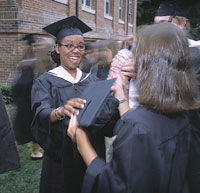
Another recent graduate, Michael Beck ’01 perhaps knows the current job market better than any other alumna/us. As a computer technician at a processing center in Concord, California, he received as many as 60,000 resumes each day for positions at various client companies.
The good news for the class of ’02 is that the 60,000 resumes a day Beck’s firm processed a year ago dropped to 10,000 this spring. Ironically for Beck, fewer resumes meant less business, downsizing, and the loss of his own job; but he said this allows him to look for something new in a better location, and he’s excited about it. Beyond his excitement, fears must lurk, too, as they do for Vassar’s newest graduates. But what would graduation — this rite of passage — be without a good challenge?
Cohen ’00 lives in Berkeley, California, and is open to suggestions on his career.